
From Chaos to Clarity
How Consolidating Campaigns Unlocked Google's AI and Lifted ROAS 55% for Mask Co
PROJECT OVERVIEW
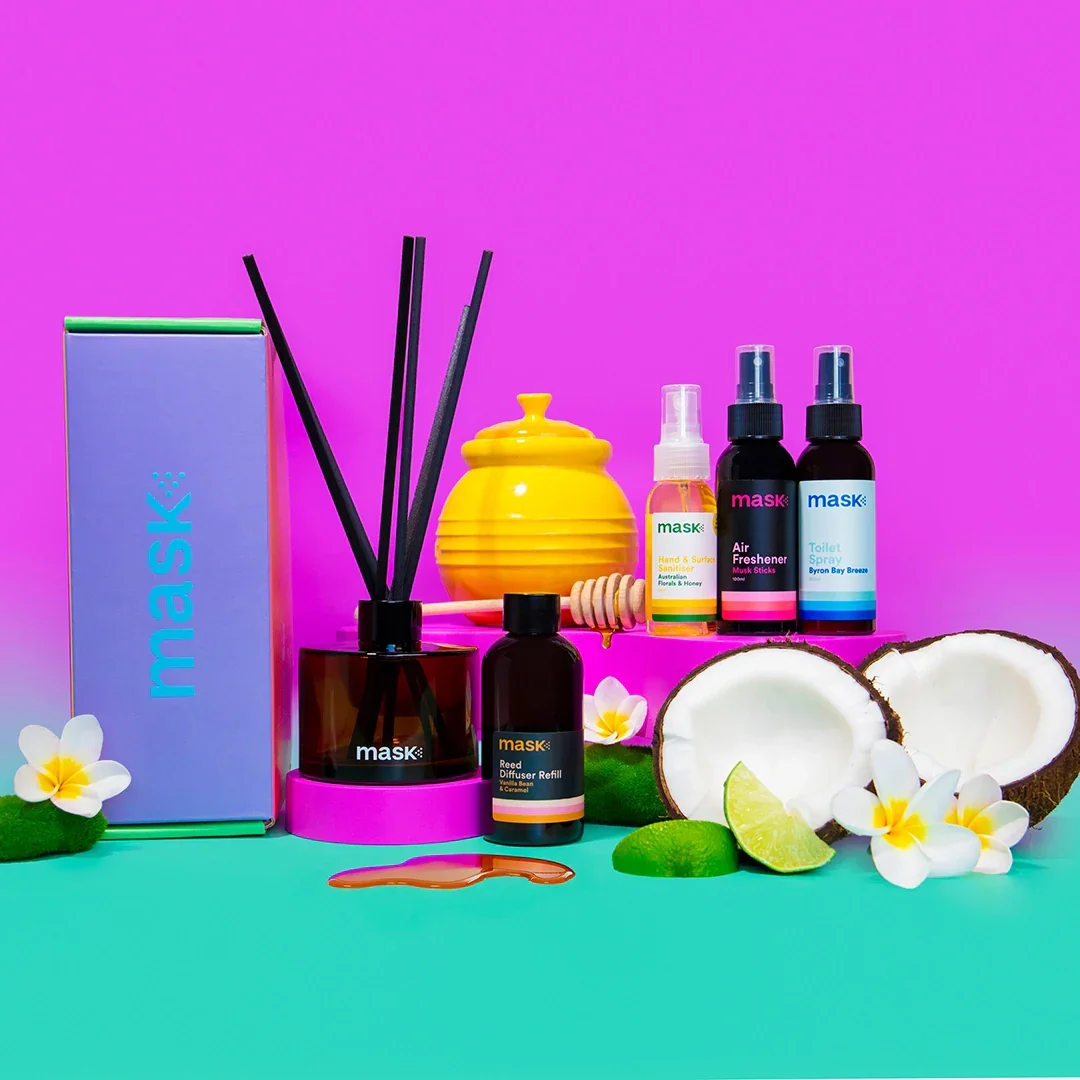
Mask Co is an Australian direct-to-consumer home fragrance brand founded in Northern NSW. Built on a $300 startup budget, the business has scaled to become a multimillion-dollar brand, selling over three million units of its signature air fresheners, toilet sprays, reed diffusers, and hand sanitisers. Known for playful, candy-inspired scents and sustainable packaging made from 100% recycled ocean and landfill plastic, Mask Co operates as a pure-play ecommerce brand at maskco.com.
When Ecom Nation began the Google Ads AI Readiness audit in November 2025, what we found was an account with years of agency layering: campaigns from four separate agencies, old Smart Shopping campaigns that should have been sunset years prior, city-specific Performance Max splits, product-silo PMax campaigns, and a naming convention that reflected a history of handoffs rather than a coherent strategy. Google's AI had no clean signal to work with. The account was spending across too many campaigns competing for the same budget and the same customers.
In 2025, we implemented the AI Readiness Framework and consolidated the entire account into three campaigns. This is the story of what happened next.
CHALLENGE & OBJECTIVES
At the point of audit, the live campaign structure included:
Multiple Performance Max campaigns split by product category (Toilet Spray PMax, Air Freshener PMax, Reed Diffuser PMax, Hand Sanitisers PMax)
City-specific Performance Max campaigns targeting Melbourne, Sydney, and Brisbane independently
Audience-segmented PMax variants (Higher New Customer, All Users, Brand)
Legacy Smart Shopping campaigns (deprecated technology, never consolidated)
Dynamic Search Ads running alongside PMax, fragmenting search signal
Display and Video remarketing from previous agencies, still active and drawing budget
The result was a fractured bidding environment. Google's Smart Bidding requires consolidated conversion data to optimise effectively. With spend and signal split across dozens of campaigns chasing the same audience pool, the algorithm was working against itself. No single campaign had enough data to enter the learning phase with confidence, tROAS targets were inconsistent across segments (ranging from 175 to 610), and budget was being consumed by legacy structures.
The client's objectives were straightforward: grow revenue from Google Ads, improve return on ad spend, and reduce wasted budget. The challenge was not a creative or copy problem. It was a structural one. The account was not ready for AI. Until that changed, no amount of optimisation at the campaign level would produce sustainable results.
STRATEGY & APPROACH
The AI Readiness Framework is built on one core principle: Google's machine learning performs best when it has clean signals, consolidated data, and a structure it can learn from without interference. Every fragmentation decision made for the sake of control or reporting granularity comes at a cost to performance.
What we did
The Performance Max Catch All campaign replaces all previous product-silo and city-specific PMax campaigns. Rather than splitting signals by category or geography, one PMax campaign receives the full budget and the full product feed, allowing Google to allocate spend dynamically across placements and audiences based on actual conversion intent.
The Brand Search campaign is maintained as a standalone at a higher tROAS target to protect branded traffic from cannibalisation and to ensure brand terms convert efficiently without competing for budget inside PMax. Always maintaining the 20/80 spend balance between Brand and Non-Brand.
Standard Shopping was running as a supplementary layer to capture high-intent product searches with explicit keyword signals, but was directing Pmax to spend in search.
The tROAS targets were set conservatively at launch to allow the campaigns to exit the learning phase with sufficient conversion volume before targets were tightened. This approach prioritises data accumulation over short-term efficiency.
What we did not do
We did not segment by product. We did not split by city. We did not create separate campaigns for new vs returning customers at launch. These are common tactics that create the illusion of control while actively reducing the data each campaign receives. The AI Readiness Framework treats consolidation as a performance lever, not a compromise.
RESULTS & IMPACT
Data pulled directly from the account for the full analysis window of 1 November 2025 to 31 January 2026, split at 25 December 2025.
Before vs After: Full Period Comparison
+55% ROAS improvement — 8.90x → 13.82x
-63% avg. daily spend reduced — $1,562/day → $572/day
13.82x blended ROAS post-restructure — $21,165 spend generating $292,474 revenue
Note: The before period includes the Black Friday / Cyber Monday sales window (14–17 November), which naturally inflates volume and revenue. The after period covers post-Christmas and January, which is a lower-demand season for home fragrance. The ROAS improvement is real despite this seasonal headwind.
Like-for-Like: Removing the BFCM Effect
A cleaner comparison uses December 1–24 (old structure, post-BFCM, pre-Christmas decline) against January 2026 (new structure, settled and out of the learning phase).
6.22x ROAS — Dec 1–24 (old structure) — $1,531/day
11.43x ROAS — January 2026 (new structure) — $564/day
+84% ROAS improvement, like-for-like — same demand conditions
In December, the old fragmented structure was spending $1,531 per day and achieving 6.22x ROAS. In January, the consolidated three-campaign structure spent $564 per day and achieved 11.43x ROAS. The account is spending 63% less per day and converting at 84% higher efficiency.
The revenue per day is lower in January, reflecting the post-Christmas slowdown. The efficiency gain, however, is structural and permanent. As the budget scales back toward pre-restructure levels within the new structure, the ROAS improvement is expected to hold.
Campaign-Level Performance (Dec 26 – Jan 31)
Three campaigns. Clean signals. No cannibalisation. The Brand Search campaign at 9.05x ROAS demonstrates strong branded demand. The PMax Catch All at 6.49x is delivering consistent volume across the full product range without category or geographic splits.
Data from 1 Nov 2025 – 31 Jan 2026 | Split at 25 Dec 2025
8.90x → 13.82x
$1,562 → $572/day
Same demand conditions
“Working with the team at Ecom Nation transformed how we think about paid social — no more guessing, just disciplined scaling. The $1.8M year blew us away.
”
Takeaway
The most impactful change in this account was not a creative test, a new bid strategy, or a new campaign type. It was structural. By removing the interference and giving Google's AI a clean, consolidated environment to operate in, the account unlocked performance that was never achievable with a fragmented structure.
For ecommerce brands running Google Ads, account complexity is not a sign of sophistication. More often, it is the primary barrier to performance. The AI Readiness Framework exists to remove that barrier.
